Andrej Leban
Andrej Leban
Home
Research
Publications
Talks
Honors & Media
Teaching
Posts
Projects
Light
Dark
Automatic
Generative Models
Energy-Tweedie accepted to NeurIPS 2026
Energy-Tweedie: Score meets Score, Energy meets Energy has been accepted to NeurIPS 2026.
Last updated on Sep 29, 2026
1 min read
Ploutos Fireside Chat on Distributional Autoencoders ...
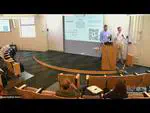
A 60-minute fireside chat on Distributional Autoencoders Know the Score, hosted by Ploutos.
Last updated on Feb 14, 2026
1 min read
New preprint: Energy-Tweedie
A short announcement of the Energy-Tweedie preprint and its publication page.
Last updated on Jan 2, 2026
1 min read
Energy-Tweedie: Score meets Score, Energy meets Energy
The classical Tweedie’s formula connects the score under Gaussian noise to the posterior mean. We generalize this result to the
Energy-Tweedie identity
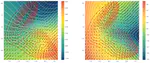
: for “energy-based” (Gibbs) noising distributions, the score is connected to a path-derivative of a kernel scoring rule induced by the noise distribution itself and evaluated at the denoising posterior. Among other things, this opens new routes to score and noise-parameter estimation, and provides the score-based perspective on diffusion approaches based on scoring rules - with the path through the (multidimensional) noise-parameter space a free design choice at sampling time.
Andrej Leban
NeurIPS 2026
(to appear)
PDF
Cite
NeurIPS
arXiv
alphaXiv
Distributional Autoencoders Know the Score
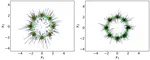
For the Distributional Principal Autoencoder (DPA), we prove an exact identity linking the geometry of the learned encoding to the score of the data distribution, and show that any latent coordinates beyond the data manifold dimension become completely uninformative. This means that the DPA learns nonlinear manifolds shaped locally by the data density, with a clear, testable dimensionality criterion — conditional independence, giving it a natural nonlinear-PCA interpretation.
Andrej Leban
NeurIPS 2025
PDF
Cite
Code
Poster
Slides
NeurIPS paper
arXiv
alphaXiv
A talk on our work on whale communication at the Simons Institute
A talk at the Simons Institute on using deep generative models to study sperm whale communication.
Last updated on Jul 11, 2023
1 min read
Approaching an unknown communication system by latent space exploration and causal inference
We propose a novel methodology -
Causal Disentanglement with Extreme Values (CDEV)
- to identify representations learned by GANs. When trained on raw whale communication, it finds - for the first time - specific acoustic attributes that might serve as carriers of meaning.
Gašper Beguš
,
Andrej Leban
,
Shane Gero
Royal Society Open Science
, 13: 250829
PDF
Cite
Code
Royal Society Open Science
Cite
×